
The Brain Song Is It Legit or Scam?
If you recently saw The Brain Song advertised as a simple way to support focus, memory, and mental clarity, you may ask an important question before buying: the brain song is it legit or scam?
That question makes sense. The product uses terms such as brainwave entrainment, gamma waves, BDNF, and cognitive performance in its marketing. Scientists study all of these concepts, but their existence does not prove that The Brain Song can deliver every benefit that its marketing suggests.
👉 Click Here to Get the 30% Discount on The Brain Stress Relief
👉 Click Here – to Discover more about The Brain Song Works
So, is The Brain Song a scam, or does it offer a legitimate digital audio product? Based on currently available product information and independent reviews, The Brain Song appears to be a real digital audio product. However, you should evaluate its marketing claims separately from the scientific evidence behind the underlying concepts. Current product pages describe it as a short daily listening program that uses gamma-oriented sound and brainwave entrainment.
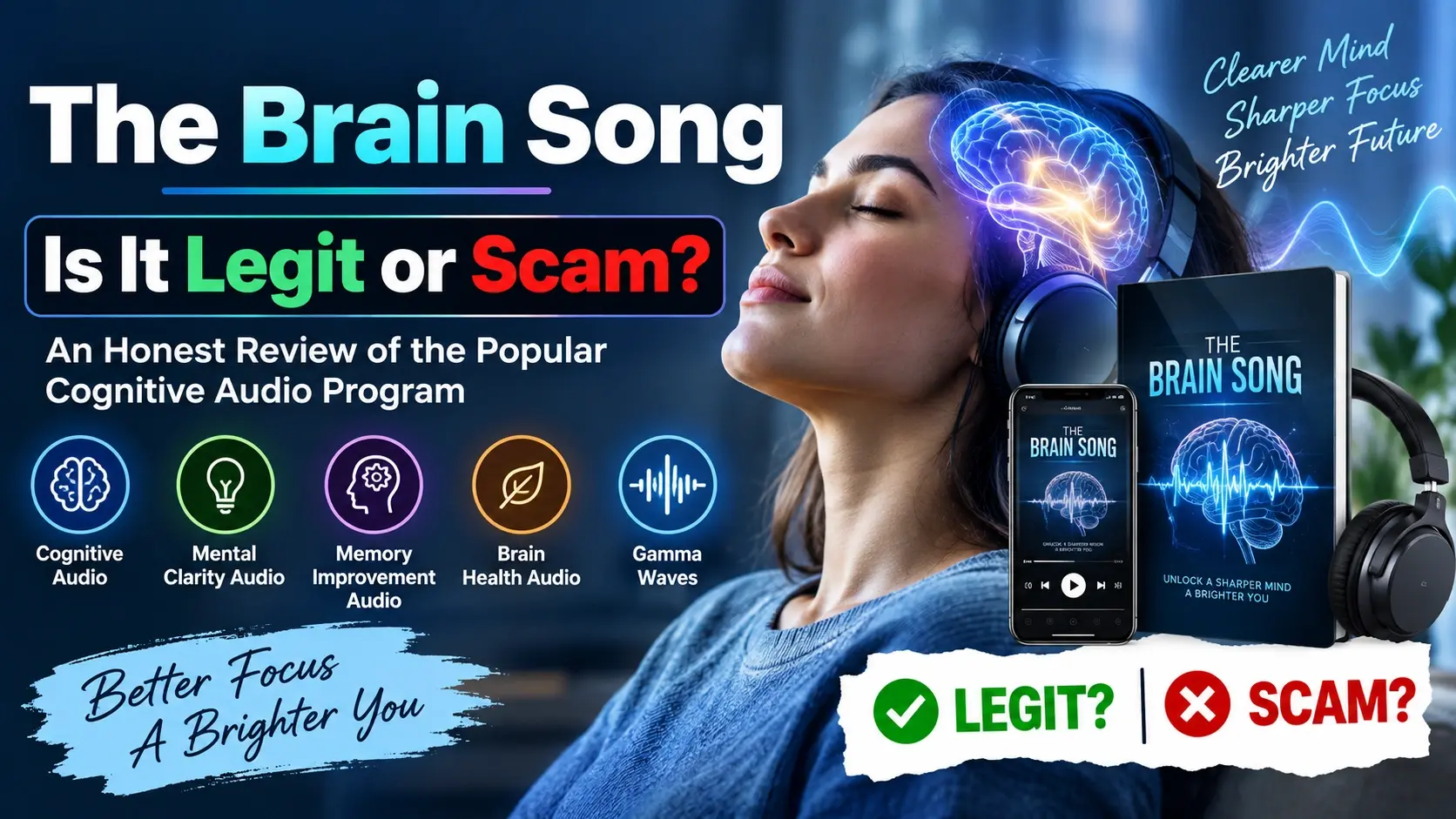
The Brain Song: Is It Legit or Scam?
Let’s start with the most important question.
A scam typically involves deception. For example, a company may take someone’s money without delivering the promised product, provide false information, or hide important purchase terms.
The Brain Song appears to operate differently. It offers a digital audio product rather than a physical supplement or medical device. Current third-party reviews also describe it as a consumer digital audio program available through a digital-product marketplace with a refund policy.
However, a legitimate product does not guarantee the results advertised in its marketing.
That distinction matters when you evaluate The Brain Song.
The marketing also refers to scientific concepts that researchers genuinely study. For example, BDNF is a neurotrophin that supports synaptic plasticity, and researchers have studied its role in learning and memory.
However, scientific research on BDNF does not automatically prove that listening to a specific commercial audio program will improve memory or cognitive performance.
In other words, the science behind the concept can be real while the specific product claims still require careful evaluation.
At the same time, evidence that a particular scientific mechanism exists is not the same as proving that a specific commercial audio program will produce meaningful improvements in every listener.
Our verdict
The Brain Song does not currently appear to be a “fake product” scam. But consumers should be careful not to confuse a real product with a clinically proven treatment.
That is the most balanced way to look at it.
What Is The Brain Song?
The Brain Song is marketed as a digital audio program designed to be used as part of a simple daily listening routine.
Current product pages describe it as a short audio session focused on brainwave entrainment and gamma-oriented sound. Some pages currently list a 17-minute version, while other online pages list a 12-minute version. Because the information varies between websites, buyers should verify the exact version, delivery method, price, and refund terms on the checkout page they are using.
Unlike a supplement, there is nothing to swallow and no ingredient list in the conventional sense. The concept is closer to cognitive audio: a digital sound experience intended to support a particular mental state or listening routine.
The appeal is obvious. Instead of adding another pill or complicated exercise program to a daily routine, users simply listen to audio.
How Does The Brain Song Work?
The main concept behind The Brain Song is brainwave entrainment.
In simple terms, brainwave entrainment refers to the idea that rhythmic sensory stimulation can influence or synchronize aspects of neural activity. The Brain Song’s marketing focuses particularly on gamma-frequency activity.
Gamma waves are a real type of neural oscillation. They are commonly discussed in neuroscience research involving attention, perception, information processing, and memory.
That makes the concept scientifically interesting. But there is an important difference between studying gamma activity in controlled research and proving that a particular commercial recording can create large, lasting improvements in cognition.
Recent research continues to investigate 40-Hz auditory stimulation and related gamma-band approaches. For example, a 2025/2026 human study in people with early-stage Alzheimer’s disease reported improvements in certain cognitive measures after a structured 40-Hz auditory intervention. However, that was a specific research intervention involving repeated sessions and controlled assessment; it does not establish that The Brain Song itself produces the same results.
That is an important distinction when evaluating the product.
What About Gamma Waves?
One of the major terms associated with The Brain Song is gamma waves.
Gamma activity generally refers to relatively fast brain oscillations, often discussed in the range of roughly 30–100 Hz depending on the research context. Because gamma activity has been associated with attention and cognitive processing, it has attracted considerable scientific interest.
The Brain Song’s marketing uses gamma-related concepts as part of its explanation for how the audio may support focus and memory.
The underlying science is not imaginary. Researchers genuinely study gamma oscillations and auditory stimulation.
But consumers should avoid a common mistake: assuming that because gamma waves are associated with certain cognitive processes, listening to a commercial audio track automatically produces those benefits.
Scientific evidence must be evaluated at the product level, not just at the buzzword level.
Can It Support Mental Clarity?
Many people are interested in mental clarity audio because they want something easy to incorporate into their routine when studying, working, reading, or concentrating.
There is nothing unusual about using sound as part of a focus routine. Background music, ambient sound, white noise, and other audio approaches can affect how people experience their environment and concentration.
The question is whether The Brain Song provides a unique cognitive advantage.
At present, I would be cautious about making strong claims. The product’s intended purpose is understandable, and some listeners may find the routine relaxing or useful for focused listening. But individual experiences can vary substantially, and the available evidence does not justify promising a dramatic transformation for everyone.
That makes it better to view the product as a wellness or productivity tool, rather than a guaranteed cognitive enhancer.
What About Memory Improvement Audio?
Another common reason people search for this type of product is memory improvement audio.
Memory is not controlled by a single mechanism. It depends on attention, learning, sleep, emotion, neural plasticity, and other interacting processes.
BDNF is one of the biological factors researchers have linked to synaptic plasticity and memory processes. Reviews in the scientific literature have identified BDNF as an important component of mechanisms involved in learning and memory.
That is scientifically relevant, but again, it does not prove that listening to The Brain Song will significantly improve a person’s memory.
A sensible buyer should therefore keep expectations realistic.
If the audio helps someone create a calm, consistent routine for studying or concentrated work, that may be useful. But it should not be treated as a substitute for established habits such as adequate sleep, regular physical activity, effective study techniques, and appropriate medical evaluation when genuine memory problems are present.
Does The Brain Song Improve Brain Health?
The product is also positioned as brain health audio, with marketing references to neuroplasticity, BDNF, memory, and cognitive performance.
The broader concept of brain health is well established, but it is much bigger than a single audio track.
Healthy brain function is influenced by many factors, including sleep, cardiovascular health, physical activity, learning, stress management, social engagement, and overall health.
Therefore, I would not evaluate The Brain Song as a complete brain-health solution.
A more reasonable interpretation is that it may be one optional component of a personal wellness routine. Whether it offers enough value to justify its price depends on the individual and on whether the buyer finds the listening experience useful.
The Brain Song Reviews: What Should Buyers Look For?
When researching The Brain Song reviews, don’t look only at star ratings or promotional testimonials.
Ask four questions:
What exactly was purchased?
Make sure the review is discussing the same product and not a different audio program or copycat website.
Was the reviewer actually using the product?
Some online pages make strong statements without showing how their conclusions were reached.
Are claims separated from evidence?
A review that simply repeats sales-page language is less useful than one that examines what can actually be verified.
Are refund and purchase terms clear?
Check the current checkout and terms before paying because prices, offers, and policies can change.
Current search results contain both favorable and highly critical reviews, which is another reason to compare the underlying evidence rather than relying on a single article.
Is The Brain Song Worth Buying?
Whether The Brain Song is worth buying ultimately depends on what you expect from it.
If you are looking for a simple digital audio product that may fit into a daily focus or relaxation routine, it may be worth investigating.
If you expect a scientifically guaranteed improvement in memory, concentration, or cognitive ability, you should be much more cautious.
The difference between those two expectations is important.
The product appears to be relatively straightforward: you are purchasing digital audio, not a prescription treatment or clinically established therapy. That means the purchase decision should be based on realistic expectations, the current price, the refund policy, and whether the product format actually appeals to you.
Pros and Cons of The Brain Song
Pros
The biggest advantage is simplicity. It is a digital product that can be used without swallowing supplements or following a complicated program.
The concept is also based on genuine scientific areas of interest, including gamma-band activity, neural entrainment, and BDNF-related neuroscience. Those research fields are real, even though that does not prove every marketing claim about this specific product.
Cons
The biggest concern is the gap between broad scientific concepts and product-specific evidence.
Strong marketing language can make a product sound more scientifically established than it actually is. Current independent reviews have also pointed out that product-specific clinical evidence is limited or not independently established.
There is also inconsistent information online about the exact audio duration and product presentation, so consumers should verify details before purchasing.
Final Verdict: Is The Brain Song Legit or a Scam?
After looking at the product concept, current product information, and available research, the fairest conclusion is:
The Brain Song appears to be a legitimate digital audio product, not simply a fake product designed to take money without delivering anything. However, that does not mean its advertised cognitive benefits are guaranteed or clinically proven for everyone.
The science behind concepts such as gamma waves, brainwave entrainment, and BDNF is genuine and continues to be studied. BDNF in particular has a well-established connection to neural plasticity and learning and memory research.
The unresolved question is how much benefit a commercial recording such as The Brain Song provides beyond the broader scientific concepts used in its marketing.
So, the brain song is it legit or scam? The best answer is: the product appears to be real, but consumers should evaluate its claims with realistic expectations and verify the current purchase and refund details before buying.
That is a much more useful conclusion than calling it either a miracle solution or an outright scam.
Frequently Asked Questions
Is The Brain Song legit?
Current information indicates that The Brain Song is a real digital audio product. However, legitimate availability does not mean that every advertised cognitive benefit has been independently proven.
Is The Brain Song a scam?
There is not enough evidence to describe the product itself as an outright scam. The more reasonable concern is whether some marketing claims go beyond the strength of the available product-specific evidence.
Does The Brain Song really work?
Some people may find the audio helpful as part of a focus or relaxation routine, but individual results can vary. Research into gamma-frequency auditory stimulation is ongoing, and existing studies should not automatically be treated as proof that The Brain Song produces the same outcomes.
What are gamma waves?
Gamma waves are relatively fast patterns of electrical activity in the brain. They are widely studied in connection with attention, perception, information processing, and memory.
Is The Brain Song a supplement?
No. It is marketed as a digital audio program rather than a nutritional supplement.
Should you buy The Brain Song?
Before purchasing, check the current price, refund terms, product duration, and official checkout information. Most importantly, approach it as an optional wellness or focus tool rather than a guaranteed treatment for memory or cognitive problems.