
How Does a Pain Relief Roll-On Work for Muscle Aches?
Muscle aches can happen after exercise, physical work, everyday activities, or minor strains. When discomfort makes normal movement less comfortable, many people look for convenient ways to manage minor aches without making their routine more complicated.
One option is a pain relief roll on, a topical product designed to be applied directly to the affected area. Unlike tablets that are taken by mouth, topical analgesics are applied to the skin over the area where relief is desired. Depending on the formulation, these products may contain ingredients such as menthol or camphor that create cooling or warming sensations while providing temporary relief from minor aches and pains.
But how exactly does a roll-on work, and what should you know before choosing one?
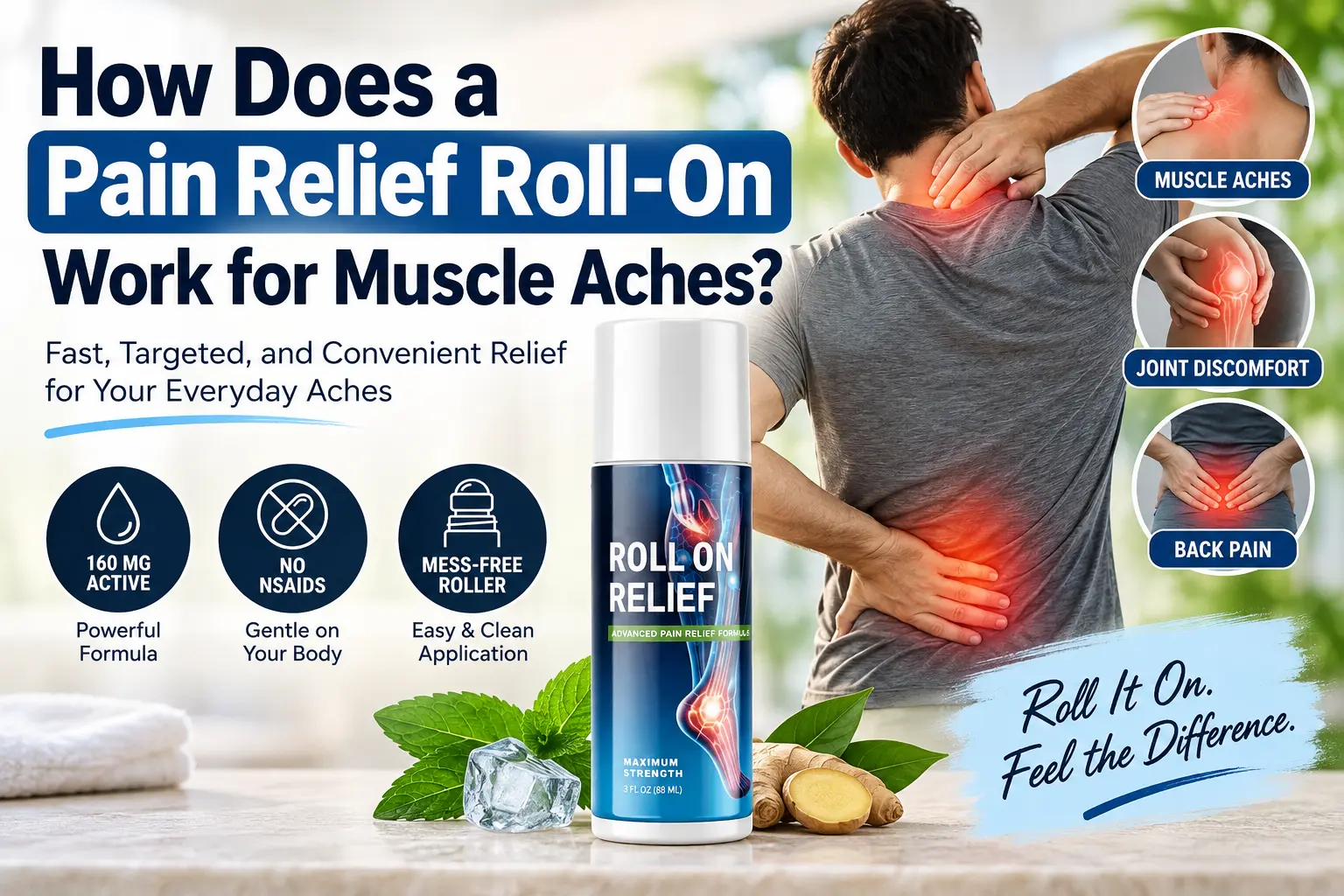
What Is a Pain Relief Roll-On?
A roll-on is a topical formulation packaged in a container with a rolling applicator. Instead of dispensing a cream or gel onto your hands, you move the applicator across the skin in the area where the product is intended to be used.
This design can be particularly convenient when you want targeted application without putting the product directly on your hands.
Topical analgesics are commonly labeled for temporary relief of minor aches and pains involving muscles and joints, including discomfort associated with simple backache, strains, sprains, bruises, and arthritis.
It is important to understand that topical pain-relief products are intended for symptom relief. They should not automatically be considered a treatment for the underlying cause of persistent or serious pain.
How Does a Topical Pain Reliever Work?
A topical analgesic is applied to the skin rather than swallowed. Ingredients in the formulation interact with the skin and can produce sensations such as cooling or warming.
For example, menthol is commonly used in topical analgesic products. Products containing menthol are labeled for temporary relief of minor aches and pains of muscles and joints.
Camphor is another ingredient frequently found in topical pain-relief products. U.S. topical analgesic products containing camphor and menthol are commonly labeled for temporary relief of minor muscle and joint aches.
The result is not necessarily the same for everyone. People can experience topical products differently depending on the formulation, concentration, application, and individual skin sensitivity.
Why Are Menthol and Camphor Commonly Used?
Menthol
Menthol is widely used in topical products because it produces a recognizable cooling sensation on the skin.
This cooling feeling can make an area feel more comfortable when you’re experiencing minor aches. Menthol is used as the active ingredient in a variety of topical analgesic products.
Camphor
Camphor is another traditional ingredient found in topical analgesic formulations. Depending on the concentration and product formulation, it can contribute to the sensory experience associated with topical pain relief.
Several U.S. topical products containing camphor and menthol are labeled as topical analgesics for temporary relief of minor aches and pains.
Other Ingredients
Some formulations also include botanical or supporting ingredients such as peppermint oil, aloe vera, turmeric, ginger, or other plant-derived ingredients.
However, the presence of a natural ingredient does not automatically mean that it has been clinically proven to treat a particular condition. When evaluating a product, pay attention to its actual Drug Facts labeling, active ingredients, directions, and warnings.
Why Choose a Roll-On Instead of a Cream or Gel?
Creams and gels can be useful, but a roll-on offers a different application experience.
1. Direct application
The applicator allows you to apply the product directly to the intended area without first dispensing it into your hands.
2. Less mess
For people who don’t like the feeling of topical products on their palms, a roll-on can be more convenient.
3. Easy to carry
A compact roll-on can be convenient to keep in a gym bag, desk drawer, travel bag, or at home.
4. Targeted application
The rolling applicator can help you focus application on the area where the product is intended to be used.
These are primarily convenience benefits. They should not be interpreted as proof that a roll-on provides better pain relief than every cream, gel, patch, or other topical formulation.
How to Use a Pain Relief Roll-On
Always follow the directions provided with the specific product you purchase. Different formulations can have different instructions and age restrictions.
In general, topical analgesic products should be applied only as directed to the appropriate area of skin.
Before using a product, read its Drug Facts label carefully.
Avoid applying topical analgesics to wounds, damaged, broken, or irritated skin. Many product labels also advise avoiding contact with the eyes and mucous membranes.
Do not assume that applying more product will provide better results. More is not necessarily better, and using a product differently from its directions can increase the risk of skin irritation or other problems.
When Might Topical Pain Relief Be Useful?
A topical analgesic may be considered for temporary relief of minor muscle and joint aches.
For example, people may look for topical options after everyday activities that leave muscles feeling sore or after minor strains or sprains.
However, pain can have many different causes. A topical product may help with symptoms without addressing the underlying cause.
If pain is severe, unusual, worsening, or persistent, it is important to seek appropriate medical advice rather than relying only on an over-the-counter topical product.
Some U.S. topical analgesic labels advise stopping use and consulting a healthcare professional if the condition worsens or symptoms persist beyond the period specified on the label.
What Makes Roll On Relief Different?
Roll On Relief is designed around the convenience of a topical roll-on format.
Its product information highlights ingredients including menthol, camphor, and peppermint oil, along with other supporting ingredients. The roll-on format is intended to make application straightforward and targeted.
Rather than presenting it as a cure for muscle pain, it is more appropriate to view Roll On Relief as a topical option intended for temporary relief of minor aches and pains, consistent with the product’s labeling.
If you’re considering Roll On Relief, review the complete product label, ingredients, directions, and warnings before use.
Roll-On vs. Cream or Gel: Which Should You Choose?
There isn’t one format that is automatically best for everyone.
A cream may be preferable to someone who wants to massage a product into a larger area. A gel may appeal to someone who prefers a particular texture. A patch can provide another application format.
A pain relief roll on may be attractive if convenience, targeted application, and avoiding product on your hands are priorities.
The most important considerations are the product’s active ingredients, directions, warnings, intended use, and whether the format fits your personal preferences.
Important Safety Information
Topical analgesics are not appropriate for every situation.
Read and follow the product label before use. For products containing ingredients such as menthol or camphor, common labeling precautions include using the product only as directed, avoiding the eyes and mucous membranes, and not applying it to damaged or irritated skin.
Some topical analgesic labels also warn against using heating pads or other local heat with the product.
If significant irritation develops, stop using the product. If symptoms worsen or persist beyond the timeframe stated on the label, consult a healthcare professional.
Keep topical products out of reach of children and follow the storage and usage instructions supplied by the manufacturer.
Frequently Asked Questions
Does a pain relief roll-on work for muscle aches?
Topical analgesics containing ingredients such as menthol or camphor are commonly labeled for temporary relief of minor muscle and joint aches. Individual results can vary depending on the product and person.
Is a roll-on better than a cream?
Not necessarily. The main difference is often application format and personal preference. A roll-on can provide convenient, targeted application without requiring you to put the product directly onto your hands.
Can I use a roll-on on damaged skin?
You should not apply topical analgesics to wounds or damaged, broken, or irritated skin unless the product’s labeling specifically says otherwise.
How often should I apply it?
Follow the exact directions on the product label. Do not increase the frequency or amount simply because you want stronger or faster relief.
When should I talk to a healthcare professional?
If your condition worsens, symptoms persist beyond the timeframe specified on the product label, or you experience significant irritation, seek appropriate medical advice.
Conclusion
A pain relief roll on can be a convenient option for people looking for temporary relief from minor muscle and joint aches. Ingredients such as menthol and camphor are commonly used in topical analgesic products, while the roll-on format can make targeted application easier.
The key is to choose a product based on its ingredients, intended use, directions, and safety information—not simply on marketing claims.
For consumers considering Roll On Relief, reviewing the product information and following the labeled directions is the best starting point. If your pain is persistent, severe, or getting worse, a healthcare professional can help determine what may be causing it and what type of treatment is appropriate.