
Can Sound Affect Brain Activity? How Audio Impacts the Brain
To understand the relationship between sound and brain activity, it helps to start with how hearing works.
👉 Discover How Sound-Based Audio May Support Focus
👉 Explore Audio for Relaxation and Mental Well-Being
When a sound is produced, it creates vibrations that travel through the air as sound waves. These waves enter the ear and eventually reach the cochlea, a structure in the inner ear that converts mechanical vibrations into electrical signals.
Those signals travel through the auditory nerve and along the auditory pathway to the brain.
In simplified form:
Sound waves → Ear → Cochlea → Auditory nerve → Brain → Auditory processing
The brain then analyzes different characteristics of the sound, including its frequency, timing, intensity, rhythm, and pattern.
But sound processing doesn’t happen in isolation.
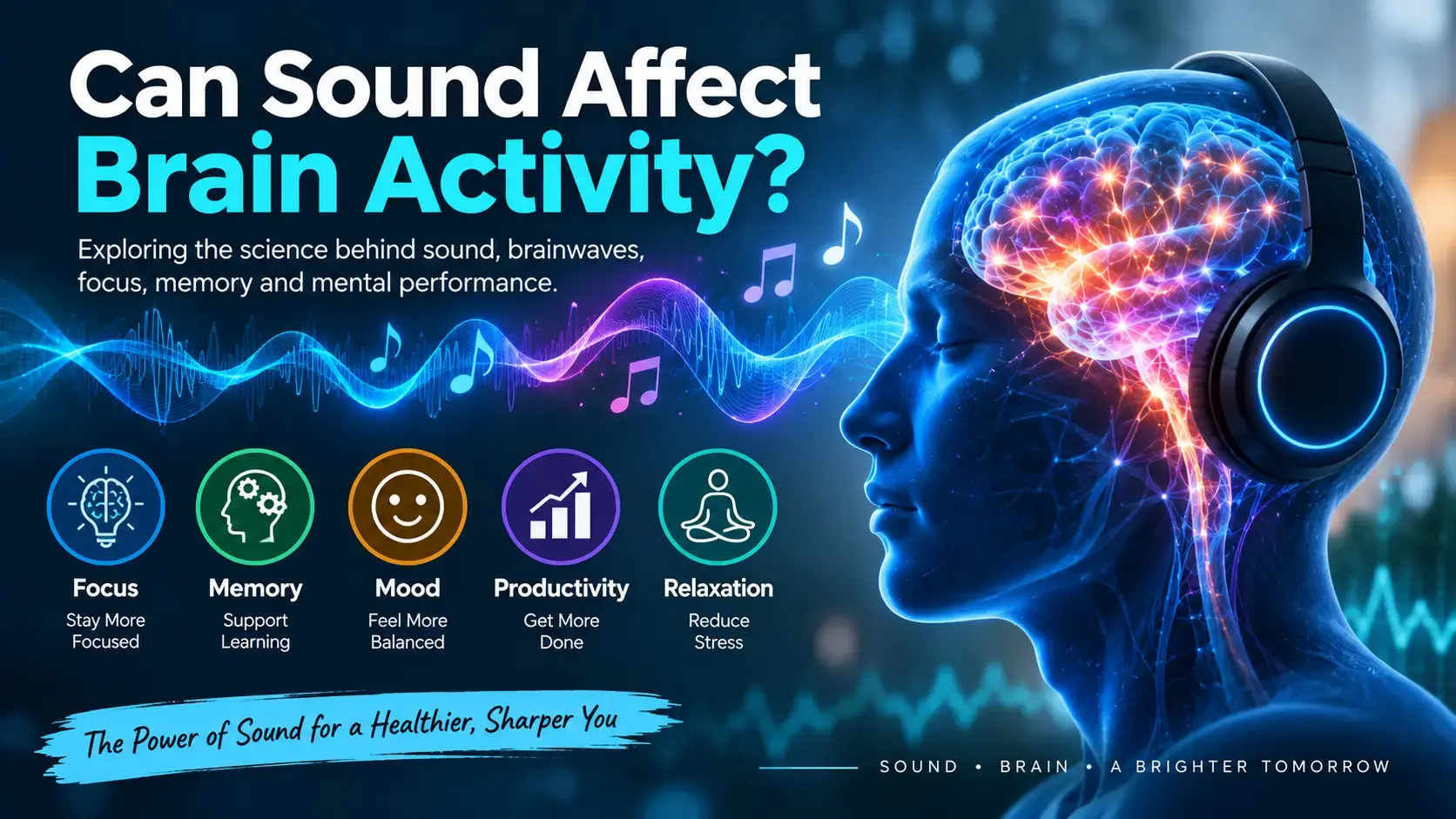
Depending on the type of sound and the situation, auditory information can interact with brain systems involved in:
- Attention
- Emotion
- Memory
- Prediction
- Language
- Movement
- Arousal
- Learning
This is one reason why a particular song can make you feel emotional, remind you of a past event, or change the atmosphere while you’re working.
Research in cognitive neuroscience shows that music, for example, involves brain systems associated with perception, action, emotion, and learning rather than a single isolated area of the brain.
So, sound can affect brain activity, but the effect depends heavily on the characteristics of the sound and the individual listening to it.
What Happens in Your Brain Activity When You Hear a Sound?
Your brain is constantly making sense of the sounds around you.
Imagine you’re sitting in a busy café.
You may hear:
- Conversations
- Background music
- Cups and plates
- Traffic outside
- Footsteps
- Machinery
Your auditory system receives all of this information, but your brain doesn’t treat every sound as equally important.
If someone says your name, for example, your attention may immediately shift toward that sound.
This demonstrates that hearing is more than simply detecting sound. The brain is continuously identifying patterns, filtering information, predicting what may happen next, and deciding what deserves attention.
Music provides an even more interesting example.
Music contains rhythm, melody, harmony, pitch, and timing. The brain processes these characteristics and makes predictions about what is likely to happen next. Research into the neuroscience of music has found that listening involves networks associated with auditory processing, emotion, action, and learning.
This helps explain why music can have such a noticeable effect on our subjective experience.
Can Sound Affect Brain Waves?
One of the most interesting questions surrounding sound and brainwaves is whether external auditory stimulation can influence the brain’s electrical rhythms.
Scientists can measure electrical activity in the brain using electroencephalography, commonly known as EEG.
You may have heard of different frequency bands such as:
- Delta
- Theta
- Alpha
- Beta
- Gamma
These terms describe ranges of neural oscillations measured using specific methods.
Researchers study these oscillations because they are associated with different aspects of brain function.
This has led to interest in auditory stimulation and brain activity.
Could rhythmic sounds interact with naturally occurring neural rhythms?
This possibility is commonly discussed under the concept of brainwave entrainment.
However, this is where online discussions can become misleading.
The existence of different brainwave frequencies does not mean that simply listening to a particular frequency automatically puts your brain into a specific state.
Real neuroscience research considers many variables, including the stimulus, duration, intensity, experimental conditions, individual differences, and the way brain activity is measured.
Therefore, it is more accurate to say that researchers are investigating whether particular forms of auditory stimulation can influence neural oscillations under certain conditions.
What Is Brainwave Entrainment?
Brainwave entrainment generally refers to the idea that rhythmic external stimulation may interact with the brain’s natural rhythmic activity.
Auditory stimulation is one approach that has been investigated.
One of the best-known examples is binaural beats.
Binaural beats involve presenting two tones with slightly different frequencies separately to each ear. The listener can perceive a rhythmic beat corresponding to the difference between those tones.
For example, if the two tones have slightly different frequencies, the auditory system can create the perception of a rhythmic fluctuation.
This has generated interest in whether binaural beats can influence attention, relaxation, memory, or brainwave activity.
But the scientific evidence is not simple or universally consistent.
A systematic review examining binaural beats and brain oscillatory activity found inconsistent results among studies, with differences in experimental methods, stimulation parameters, and EEG measurements.
That means binaural beats are a legitimate research topic, but they should not automatically be described as a proven method for dramatically changing cognitive performance.
How Does Music Affect the Brain?
Music is probably the most familiar example of how sound affects the brain.
Think about how different songs can change your mood.
A relaxing piece of music may feel calming, while energetic music may make you feel more alert. A familiar song may bring back memories associated with a particular period of your life.
These experiences aren’t surprising from a neuroscience perspective.
Music contains complex combinations of rhythm, melody, harmony, timing, and emotional associations. Research has found that music processing involves multiple brain systems and is closely connected with prediction, emotion, action, and learning.
The relationship between music and emotion is particularly interesting. Neuroscience research has identified involvement of several brain structures during the processing of emotionally meaningful music.
However, the effects aren’t identical for everyone.
One person may find instrumental music helpful while studying. Another person may find it distracting.
Someone may enjoy energetic music while exercising but prefer silence while doing complicated reading.
Therefore, there is no single type of audio that is guaranteed to work the same way for every person.
Can Sound Affect Focus and Concentration?
This is one of the most practical questions related to sound and concentration.
The answer depends on the circumstances.
Some people prefer silence when working. Others find certain types of background audio useful.
For example, predictable background sound may help mask distracting environmental noise.
On the other hand, music with lyrics may compete for attention during activities that require reading or language processing.
The important factor is the relationship between the audio and the task.
Sound may influence your focus through several mechanisms:
1. Masking distractions
Consistent background sound can sometimes make unpredictable environmental noise less noticeable.
2. Creating a routine
Listening to the same type of audio before starting work may become part of a personal focus routine.
3. Changing arousal
Music and other sounds can influence how alert or relaxed someone feels.
4. Competing for attention
Complex or highly engaging audio can also become a distraction.
This is why saying “sound improves concentration” is too broad.
A better conclusion is that different types of sound can influence attention differently depending on the person, environment, and task.
Can Sound Affect Memory?
Sound can also interact with memory.
Almost everyone has experienced the feeling of hearing an old song and suddenly remembering a particular person, place, or period of life.
Why does this happen?
Auditory information can become associated with experiences and emotions. Music in particular can involve networks responsible for memory, emotion, prediction, and other cognitive processes.
But there’s an important distinction:
A sound triggering a memory is not the same as a sound automatically improving memory.
Research into auditory stimulation and cognitive performance continues to investigate whether particular sound patterns can influence memory-related tasks.
Some studies have reported potential effects, while others have not found consistent benefits.
Therefore, it would be misleading to claim that simply listening to a particular audio frequency will guarantee better memory.
Can Sound Frequencies Affect the Brain?
You may encounter many claims online about particular sound frequencies and the brain.
Some discussions focus on specific frequencies associated with alpha, beta, theta, or gamma activity.
The underlying topic is legitimate because researchers do study neural oscillations and the possible effects of rhythmic sensory stimulation.
But frequency alone doesn’t tell the whole story.
Researchers also have to consider:
- How the sound is delivered
- How long it is played
- Volume
- Background environment
- Whether the listener is actively performing a task
- Individual differences
- Experimental design
- How brain activity is measured
This is why claims such as “this frequency will instantly increase your intelligence” should be treated cautiously.
A scientific finding about a particular experimental condition should not automatically be converted into a broad consumer claim.
What Is Auditory Stimulation?
Auditory stimulation is a broad term describing the use of sound as a stimulus for the auditory system.
It can include:
- Music
- Rhythmic tones
- Nature sounds
- White noise
- Spoken audio
- Binaural beats
- Other specially designed audio patterns
Researchers have investigated auditory stimulation in relation to attention, emotion, arousal, cognition, and neural activity.
The important point is that these different types of sound aren’t interchangeable.
Music is different from white noise.
White noise is different from binaural beats.
Binaural beats are different from a structured audio program.
Therefore, evidence involving one type of auditory stimulation should not automatically be used as proof for another.
Can Audio Influence Brain Activity?
The broader question of audio and brain activity has become particularly interesting with the development of digital audio programs.
Some programs are designed around relaxation, meditation, concentration, productivity, or brainwave-related concepts.
The underlying idea is relatively simple:
Listen to specially designed audio as part of a particular routine.
One example in this category is Genius Switch, which is marketed as a digital brain-audio program.
The important thing for consumers is to separate two different questions:
Question 1: Can sound affect the brain?
There is scientific evidence that auditory information is processed by the brain and can influence neural activity and psychological states.
Question 2: Does a particular commercial audio program produce specific promised results?
That requires evidence about the specific product.
Research into music, auditory stimulation, or brainwave entrainment in general does not automatically prove that every commercial audio program produces the same effects.
This distinction is important when evaluating any product in the brain-audio category.
Genius Switch and the Science of Sound
Genius Switch is positioned as an audio-based digital product rather than a supplement or physical device.
Its concept fits into the broader consumer interest in:
Sound → auditory stimulation → brain activity → focus and mental performance
However, the existence of scientific research into these general concepts should not be interpreted as independent proof that the Genius Switch program itself produces every result mentioned in promotional materials.
If you’re specifically interested in the product, our detailed review can help you look at the offer separately from the broader science:
Genius Switch Review: Does This Brain Audio Program Work?
This distinction also makes your research more useful.
Instead of assuming that “science exists, therefore the product works,” you can ask:
- What does the product actually contain?
- How is it intended to be used?
- What does the company claim?
- What evidence supports those claims?
- What remains uncertain?
- What does the refund policy say?
That is a much more sensible way to evaluate an online audio product.
Does Listening to Audio Make You Smarter?
This is probably one of the biggest misconceptions surrounding brain-audio products.
There is interesting research into music, auditory stimulation, brainwave activity, attention, and memory.
But this doesn’t establish that listening to a particular recording will make someone universally “smarter.”
Cognitive performance depends on many factors, including:
- Sleep
- Learning
- Practice
- Stress
- Physical activity
- Environment
- Attention
- Individual differences
Audio can potentially become one part of a personal routine, but it shouldn’t be viewed as a replacement for fundamental habits that support learning and cognitive performance.
The same principle applies to commercial brain-training products.
A reasonable approach is to treat them as something you can investigate rather than assuming that a specific recording will produce guaranteed cognitive changes.
Can Loud Sound Affect the Brain and Hearing?
There is another side of the conversation that shouldn’t be ignored.
Not all sound is beneficial.
Excessively loud or prolonged sound exposure can damage hearing.
The World Health Organization explains that the risk depends on factors including sound level, duration, and frequency of exposure. Prolonged exposure to loud sounds can contribute to permanent noise-induced hearing loss and tinnitus.
This is especially relevant for people who regularly use headphones.
WHO currently recommends keeping personal-device volume below about 60% of maximum and taking breaks from loud listening. It also recommends monitoring sound exposure where possible.
So if you’re experimenting with audio programs, there is no reason to turn the volume up excessively.
More volume does not mean more cognitive benefit.
Safe listening should always be the priority.
Sound and Brain Activity: What We Know
Let’s summarize the strongest points.
We know that:
- The auditory system converts sound into neural signals.
- The brain actively processes sound characteristics such as frequency, timing, and patterns.
- Music can engage brain systems involved in emotion, learning, action, and prediction.
- Sound can influence attention and emotional responses.
- Researchers can measure changes in neural activity associated with auditory stimulation.
- Brainwave entrainment and binaural beats are legitimate areas of scientific investigation.
But there are still important questions:
- Which audio patterns work best for specific tasks?
- How large are the effects?
- How long do effects last?
- Why do people respond differently?
- Which findings can be reproduced consistently?
- Do commercial audio programs produce the same effects observed in laboratory experiments?
These unanswered questions are why it is important to avoid exaggerated claims.
Can Sound Affect Brain Activity? The Bottom Line
So, can sound affect brain activity?
Yes.
Sound is not simply something we hear. It is information processed by the nervous system, and auditory input can interact with brain systems involved in attention, emotion, memory, perception, and other cognitive processes.
Music provides a clear example. Research shows that music engages multiple brain systems and can be associated with emotional and cognitive responses.
Researchers are also studying auditory stimulation, brainwave activity, binaural beats, and brainwave entrainment. However, findings can vary depending on the experimental conditions, and the evidence should not be simplified into claims that one sound frequency will automatically produce a specific mental state.
For people interested in audio-based brain programs, this distinction is particularly important.
The science showing that sound can affect brain activity is different from proof that a particular commercial audio program will produce a specific result.
That doesn’t make audio-based programs uninteresting. It simply means they should be evaluated realistically and based on the evidence available for the specific product.
If you’re curious about Genius Switch, you can read our detailed Genius Switch Review to learn more about the program, how it is presented, what it offers, and what to consider before purchasing.
Frequently Asked Questions
Can sound affect brain activity?
Yes. Sound is converted into neural signals by the auditory system and processed by the brain. Different sounds can influence attention, emotion, arousal, and other aspects of brain activity.
How does sound affect the brain?
Sound enters the auditory system, where vibrations are converted into neural signals. The brain then processes characteristics such as frequency, timing, intensity, and patterns while interacting with other neural networks.
Can sound affect brainwaves?
Researchers have investigated whether rhythmic auditory stimulation can interact with neural oscillations. However, the strength and consistency of these effects vary across studies.
Can music affect the brain?
Yes. Music involves multiple brain systems associated with auditory perception, emotion, prediction, action, and learning.
Can sound improve concentration?
Some people may find particular sounds helpful for creating a consistent focus environment or masking distractions. However, there is no single type of sound proven to improve concentration for everyone.
What is brainwave entrainment?
Brainwave entrainment refers to the idea that rhythmic external stimulation may interact with the brain’s natural rhythmic activity. Auditory stimulation is one method researchers have investigated.
What are binaural beats?
Binaural beats are created when slightly different tones are presented separately to each ear, producing the perception of a rhythmic beat. Researchers have studied whether they can influence brain activity and cognitive performance.
Can sound improve memory?
Sound can interact with memory and emotional associations, particularly music. However, this doesn’t mean that listening to a particular sound automatically improves memory performance.
Is brainwave audio scientifically proven?
Brainwave-related audio is an area of ongoing research. Some studies report interesting effects, but findings vary depending on the type of stimulation and experimental conditions. It is better to avoid treating every commercial brainwave-audio claim as scientifically established.
Is Genius Switch scientifically proven?
Genius Switch is a commercial audio program. Research into sound, auditory stimulation, and brainwave activity should not automatically be interpreted as independent clinical proof of the effectiveness of the specific Genius Switch program.