
Can You Make Money with AI YouTube Videos in 2026?
Can you make money with AI YouTube videos in 2026? Yes, it is possible to use artificial intelligence to help create YouTube content and build different revenue streams. But AI itself does not guarantee views, subscribers, monetization, or income.
The real opportunity is using AI to make the content-creation process faster while still providing something original, useful, entertaining, or valuable to viewers.
AI can help with topic research, scripts, voiceovers, visuals, editing, captions, thumbnails, and other parts of production. However, successful channels still need good ideas, human judgment, quality control, audience understanding, and consistency.
In this guide, you’ll learn how AI YouTube channels can make money, how to create videos with AI, what YouTube’s current policies mean for AI-generated content, and the mistakes you should avoid.

Can You Really Make Money with AI YouTube Videos?
Yes, but there is an important difference between using AI to create content and simply uploading large quantities of automatically generated videos.
AI can reduce the time required to produce videos, but viewers still decide whether a video deserves their attention.
A successful AI-assisted YouTube channel usually combines:
- AI-assisted research
- Original ideas
- Well-written scripts
- Appropriate visuals
- Good narration
- Effective editing
- Attractive thumbnails
- Strong titles
- Audience-focused content
- Regular performance analysis
You can potentially make money through several different methods rather than relying entirely on YouTube advertising.
How Do AI YouTube Channels Make Money?
There are several potential revenue streams available to YouTube creators.
1. YouTube Advertising Revenue
Once a channel meets the applicable requirements and is accepted into the YouTube Partner Program, eligible videos can earn revenue from advertising and other YouTube monetization features.
However, getting accepted is not automatic. YouTube reviews channels for compliance with its monetization policies, and creators must follow the relevant rules.
Your potential advertising revenue can vary significantly depending on factors such as:
- Number of views
- Audience location
- Topic and niche
- Viewer engagement
- Watch time
- Advertiser demand
- Video format
Therefore, it is better to avoid claims that a particular number of views will produce a guaranteed amount of money.
2. Affiliate Marketing
Affiliate marketing can be another useful monetization method.
For example, imagine you create a channel about AI tools. You could publish videos explaining:
- AI video generators
- AI writing tools
- AI voice software
- Video editing software
- Thumbnail tools
- Productivity tools
If an appropriate affiliate program is available, you can provide an affiliate link and potentially earn a commission when viewers make qualifying purchases.
This can be particularly interesting because the same audience that watches tutorials about AI may also be interested in the tools being demonstrated.
3. Sponsorships
As a channel develops a relevant audience, companies may become interested in sponsoring videos.
For example, an AI-focused channel could potentially work with companies offering software, productivity tools, online services, or creator products.
Sponsorship income depends on factors such as audience quality, niche, engagement, channel size, and the advertiser’s objectives.
4. Digital Products
You can also use YouTube to promote your own digital products.
Examples include:
- Ebooks
- Templates
- Courses
- Checklists
- Design resources
- Educational materials
- Software
- Memberships
In this model, YouTube becomes a source of targeted traffic rather than the only source of income.
5. Services
An AI-related YouTube channel can also generate leads for services.
For example, a creator could offer:
- Video editing
- AI content creation
- Thumbnail design
- YouTube channel setup
- Social media services
- Website services
- Consulting or training
This approach can work particularly well when videos demonstrate expertise rather than simply promoting products.
Can AI-Generated YouTube Videos Be Monetized?
This is one of the most important questions to understand before starting an AI YouTube channel.
Using AI does not automatically make a channel ineligible for monetization.
However, YouTube’s monetization policies require content to be original and authentic. YouTube specifically says that repetitive or mass-produced content can be ineligible for monetization. Its current policy also explains that content should provide meaningful creative, educational, or entertainment value rather than simply being produced from repetitive templates.
This means there is a major difference between:
AI-assisted original content
and
mass-produced, repetitive AI content.
For example, using AI to help research a topic, develop an outline, improve a script, create visuals, or assist with editing can be part of a legitimate production workflow.
The problem arises when dozens or hundreds of videos are produced using essentially the same template with little meaningful variation or original value.
YouTube’s policy specifically gives examples of content that may be unsuitable for monetization, including highly repetitive content, templated videos with minimal value, and AI-generated content that appears mass-produced without original insights or perspective.
So the goal should not be:
Create as many AI videos as possible.
A better goal is:
Use AI to create better content more efficiently.
Does YouTube Allow AI-Generated Content?
Yes, AI-assisted and AI-generated content can appear on YouTube, but creators need to understand the disclosure requirements.
YouTube requires creators to disclose certain AI-generated or meaningfully altered content when it appears realistic. Examples include making a real person appear to say or do something they did not actually say or do, altering footage of a real event, or creating a realistic scene that did not happen.
On the other hand, YouTube says creators generally don’t need to disclose ordinary production assistance such as AI-generated outlines, scripts, thumbnails, titles, captions, or minor editing assistance.
Importantly, YouTube states that disclosure itself does not automatically make content ineligible to earn money.
The safest approach is to understand the current rules and disclose realistic synthetic or altered content when required.
How to Create YouTube Videos with AI
You don’t need to automate every part of the process.
A practical AI-assisted workflow can look like this:
Step 1: Choose a Specific Niche
Don’t start with a channel about “everything AI.”
Choose a focused audience and topic.
Examples could include:
- AI tools
- Technology tutorials
- Educational content
- Productivity
- Personal finance education
- Software tutorials
- History and storytelling
- Business education
- Creative tutorials
A focused niche makes it easier to understand what your audience wants.
Step 2: Research Video Topics
Look for questions people actually want answered.
Instead of creating random videos because an AI tool suggested them, research:
- Search queries
- Common questions
- Competitor topics
- Comments
- Trends
- Problems people are trying to solve
AI can help organize research, but important facts should still be checked before publication.
Step 3: Create the Script
AI can help create an outline or first draft.
However, don’t publish the first AI-generated script without reviewing it.
Check:
- Accuracy
- Repetition
- Natural language
- Examples
- Facts
- Story structure
- Viewer value
Add your own perspective wherever possible.
Step 4: Create the Voiceover
You can use recorded narration or an AI voice depending on the type of content and your production setup.
The important thing is that the narration should sound appropriate for the audience and support the video’s purpose.
Step 5: Create the Visuals
Depending on your niche, you might use:
- Screen recordings
- Original graphics
- AI-generated visuals
- Licensed stock footage
- Animations
- Charts
- Demonstrations
- Original video clips
Don’t simply download other people’s videos and make minor changes.
YouTube’s reused-content policy looks at whether meaningful original value has been added to material taken from elsewhere.
Step 6: Edit the Video
Editing should improve the viewing experience.
Use:
- Captions
- Visual changes
- Appropriate transitions
- Music where appropriate
- Screen recordings
- B-roll
- On-screen text
- Chapters for longer videos
The goal isn’t to make the video look artificially busy. Every visual element should support the content.
Step 7: Create a Strong Thumbnail
A thumbnail should communicate the video’s idea quickly.
Avoid misleading thumbnails.
A good thumbnail should create curiosity while accurately representing what the viewer will get.
Step 8: Optimize the Title and Description
Use the main topic naturally in the title.
For example:
Can You Make Money with AI YouTube Videos in 2026?
is more useful than a vague title such as:
This AI Trick Will Change Everything!
Your description can explain what the video covers and include relevant supporting terms naturally.
Best AI Tools for Creating YouTube Videos
There isn’t one tool that is perfect for every channel.
Different tools can handle different parts of production.
| Tool category | Main purpose |
|---|---|
| AI writing tools | Research, outlines and scripts |
| AI voice tools | Narration |
| AI video generators | Video creation |
| AI image generators | Custom visuals |
| Video editors | Editing and captions |
| Thumbnail tools | Thumbnail creation |
| SEO tools | Topic and keyword research |
Some newer platforms attempt to combine several of these functions into one dashboard.
This can save time, particularly for creators who want to experiment with faceless or AI-assisted channels.
However, before buying an AI YouTube automation platform, check exactly what is included.
Look for:
- Video generation limits
- AI voice limits
- Credits
- Rendering limits
- Export quality
- Commercial rights
- YouTube integration
- Number of supported channels
- Subscription requirements
- Refund terms
- Customer support
A low upfront price doesn’t necessarily mean unlimited usage.
How Much Money Can You Make with AI YouTube Videos?
There is no reliable fixed amount.
Two channels with the same number of views can generate very different revenue.
For example, income can be affected by:
- Audience country
- Niche
- Video length
- Advertiser demand
- Viewer demographics
- Watch time
- Monetization method
- Affiliate conversion rates
- Sponsorship opportunities
This is why you should treat income examples as possibilities rather than promises.
A better strategy is to build multiple revenue streams.
For example:
YouTube videos → audience → affiliate products → digital products → services
This reduces your dependence on advertising alone.
Why Most AI YouTube Channels Don’t Make Money
AI has made video production easier, but easier production also means more competition.
Some common problems include:
Choosing a weak niche
If there isn’t enough audience demand, producing more videos won’t necessarily solve the problem.
Publishing generic AI scripts
Viewers can quickly lose interest when videos feel like generic machine-generated articles being read aloud.
Using repetitive templates
If every video follows almost exactly the same format, the channel may provide little unique value.
Poor thumbnails
Even a good video can struggle if viewers don’t understand why they should click.
Weak introductions
The first part of a video needs to establish what the viewer will gain from watching.
Ignoring analytics
Publishing videos without studying audience behavior makes it difficult to improve.
Relying only on AdSense
Advertising is only one potential revenue stream.
Ignoring YouTube policies
A channel built around shortcuts that conflict with monetization rules can face problems later.
Is AI YouTube Automation Worth It in 2026?
AI YouTube automation can be useful, but it should be viewed as a production system rather than a money-making button.
Potential advantages
- Faster research
- Faster script development
- Easier content production
- Assistance with voiceovers
- Faster editing
- Easier creation of visuals
- Ability to experiment with different content formats
Potential limitations
- AI output can contain errors
- Quality still requires human review
- Competition is increasing
- AI tools can have usage costs
- Automated content can become repetitive
- Monetization is not guaranteed
- Platform policies can change
The strongest approach is therefore AI-assisted YouTube, not completely hands-off YouTube.
Let AI handle repetitive production tasks while you remain responsible for the ideas, quality, accuracy, creativity, and final decision-making.
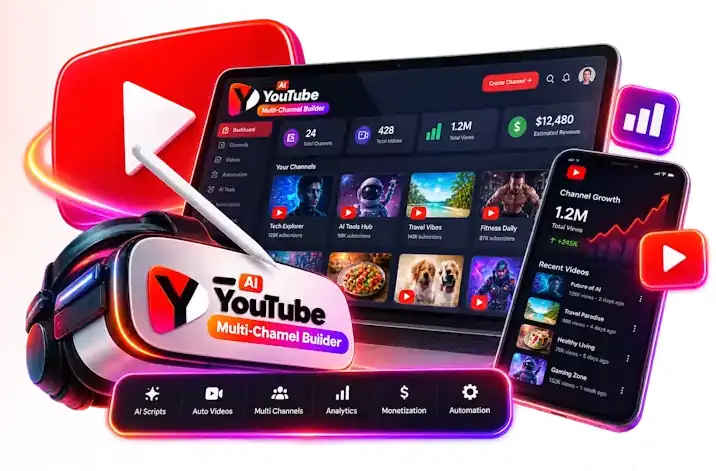
If you want to simplify the production process, an AI YouTube Multi-Channel Builder can bring several YouTube content-creation tasks into one workflow.
Creators who want to experiment with a more automated workflow can also explore an AI YouTube video creation and channel-building platform before deciding whether it fits their needs.
Conclusion: Can You Make Money with AI YouTube Videos in 2026?
So, can you make money with AI YouTube videos in 2026?
Yes, but AI is not the business model by itself.
The opportunity comes from combining AI with a good niche, original ideas, useful content, strong presentation, consistent publishing, and a sensible monetization strategy.
You can potentially earn through YouTube advertising, affiliate marketing, sponsorships, digital products, and services.
At the same time, creators should understand that YouTube’s monetization policies focus on original and authentic content. Repetitive, mass-produced, or minimally valuable content can create monetization problems.
AI should therefore be treated as a tool that helps you create, not a replacement for creativity and audience understanding.
If you can use AI to produce genuinely useful videos faster while maintaining originality and quality, there is a real opportunity to build a YouTube business around it.
The question isn’t simply:
“Can AI make YouTube videos?”
It can.
The more important question is:
“Can you use AI to create videos that people genuinely want to watch?”
That is where the long-term opportunity lies.